Photovoltaic Subsidies in Germany 2025 – Key Programs and Benefits
In 2025, photovoltaic (PV) subsidies remain a central element of Germany’s energy transition. A wide range of federal, state, and municipal programs are available to support households, companies, and communities in adopting solar power. Key instruments include low-interest loans, feed-in tariffs, consulting subsidies, and tax exemptions.
- KfW Loan 270 – Financing Renewable Energy Projects
The KfW Loan 270 program provides long-term, low-interest financing covering up to 100% of project costs. Eligible expenses include solar modules, installation, planning, grid connection, and even battery storage combined with PV.
- Eligible applicants: private households, SMEs, municipalities, non-profits, freelancers
- Maximum funding: €150 million per project
- Interest rates from 3.76%, depending on creditworthiness and market conditions
- Flexible repayment, often with initial grace periods
- Combining Subsidies – Maximizing Benefits
The KfW loan can be combined with:
- EEG feed-in tariffs (guaranteed payments for solar power fed to the grid)
- Municipal incentives (regional bonuses and local subsidy schemes)
This combination significantly lowers entry barriers for both residential and commercial projects.
- BAFA Support – Energy Consulting
Although the Federal Office of Economics and Export Control (BAFA) no longer directly funds PV systems, it subsidizes 50% of professional energy consulting costs. This ensures that PV projects are based on efficient design and long-term reliability.
- EEG Feed-in Tariff – Guaranteed Revenues
The Renewable Energy Sources Act (EEG) secures stable income for PV system owners by guaranteeing fixed tariffs for 20 years.
- Remuneration depends on system size, commissioning date, and type of feed-in (surplus or full).
- For systems commissioned between Feb 1 – July 31, 2025, updated tariff tables apply.
Plant size | Partial feed-in | Full feed-in
Up to 10 kWp | 7.94 cents | 12.60 cents
10 to 40 kWp | 6.88 cents | 10.56 cents
40 to 100 kWp | 5.62 cents | 10.56 cents
- Tax Advantages – Cutting Investment Costs
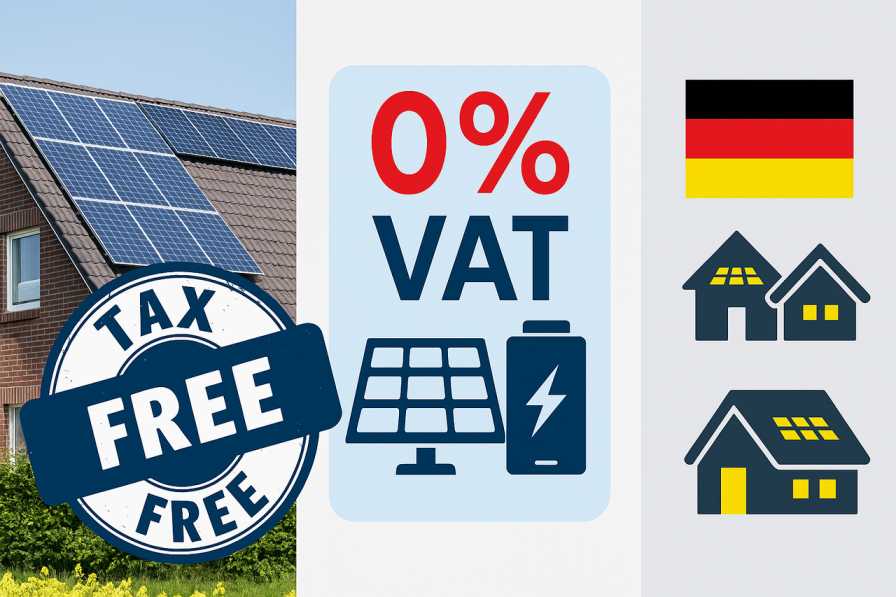
Since January 1, 2023, all PV systems up to 30 kWp are exempt from VAT (0%).
- This provides 19% upfront savings on modules, inverters, mounting systems, and batteries.
- Income tax exemption also applies for self-consumed or grid-fed electricity, retroactive from 2022.
Conclusion
Germany’s PV subsidy landscape in 2025 makes solar energy more affordable than ever. With the combination of loans, tariffs, consulting support, and tax relief, both homeowners and businesses can benefit from significantly reduced investment costs while contributing to the country’s renewable energy transition.
Reference: immo.info – Photovoltaik Förderung 2025