Solar Panel Property Tax in Germany 2025: What Owners Should Know
In Germany, anyone feeding electricity from a photovoltaic (PV) system into the public grid is usually considered a commercial operator. However, recent reforms have simplified taxation for small PV systems, particularly from 2022 onward, making solar energy more appealing for households and businesses.
Income Tax Exemption
Since January 1, 2022, PV systems up to 30 kWp on single-family homes, garages, and commercial buildings are exempt from income tax. From 2025, this threshold also applies per residential unit in multi-family and mixed-use buildings. The exemption covers feed-in payments, tenant electricity, EV charging, subsidies, VAT refunds, and self-consumption. As income is tax-free, related expenses can no longer be deducted.
Trade Tax Simplification
Systems up to 30 kWp are also exempt from trade tax if: (1) the system is income-tax exempt, (2) it was purchased at a zero VAT rate, and (3) the operator is not VAT-liable (e.g., small business rule).
VAT (Zero Tax Rate)
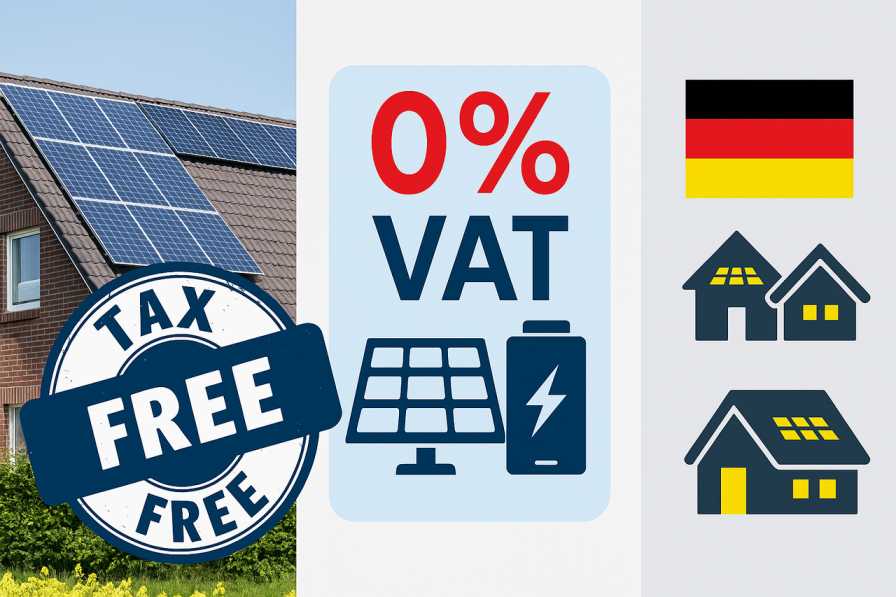
Since January 1, 2023, no VAT is charged on new PV systems up to 30 kWp for residential or public buildings. This includes solar modules, inverters, mounts, batteries, and other essential parts. Operators also no longer pay VAT on self-consumed electricity or feed-in revenues.
Battery Storage Special Status
Battery storage purchased together with a PV system is treated as part of the installation and benefits from the same zero VAT rate. Expansions with storage are also tax-free. Only standalone battery storage unrelated to a subsidized PV system is subject to regular VAT.
Conclusion
By 2025, small PV systems (≤30 kWp) enjoy a unique tax advantage: no income tax, no trade tax, and zero VAT. These reforms cut upfront costs, reduce bureaucracy, and make solar energy an even more attractive investment for households seeking lower bills and energy independence.
Reference: Vattenfall – PV-Anlagen Steuern